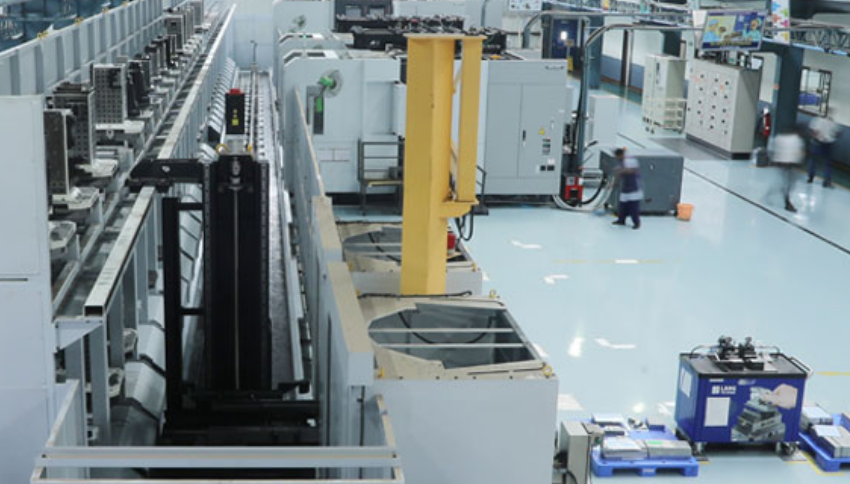
Manufacturing floors today operate under conditions that rarely resemble the stable, high-volume environments for which traditional production lines were originally designed. Demand patterns shift more frequently. Product variants multiply. Changeover windows shrink. In this environment, production systems built around a single product type or a fixed sequence of operations create structural vulnerabilities that compound over time.
For plant engineers and operations managers, the challenge is not simply producing more. It is producing reliably across varying conditions without rebuilding infrastructure each time requirements change. That distinction is where the architecture of a production system becomes a strategic operational decision, not just a procurement question.
This breakdown examines what a flexible manufacturing system actually is at a technical and operational level, how its core components interact, where it delivers measurable value, and what plant engineers need to understand before adopting one.
Defining the Flexible Manufacturing System in Technical Terms
A flexible manufacturing system is an integrated production arrangement in which automated workstations, material handling equipment, and centralized control software work together to process a defined family of parts or products without manual reconfiguration between production runs. The system is designed to accommodate variation — in part geometry, processing sequence, batch size, or product mix — while maintaining consistent throughput and quality across those variations.
The term is sometimes used loosely to describe any adaptable production setup, but in engineering practice, a flexible manufacturing system refers to a specific class of automated system with defined characteristics: computer-controlled machine tools, an automated transport mechanism linking those machines, and a system-level control architecture that manages scheduling, routing, and monitoring without human intervention at the operational level.
What separates this from conventional automation is the degree of self-direction. A traditional automated line runs one product type efficiently and breaks operational continuity the moment a different part enters the sequence. A flexible system is architected from the beginning to handle that variation as a normal operating condition, not an exception.
The Role of System Integration in Flexibility
Integration is the technical mechanism that makes flexibility possible. Individual machines, however capable, do not constitute a flexible system on their own. It is the communication layer between machines — shared data on part identity, processing status, tool availability, and queue depth — that allows the system to adapt dynamically.
When a workstation reports a tool change requirement or an upstream delay, the system-level controller can reroute work to an alternative station, adjust scheduling priorities, or buffer in-process parts without stopping production. This real-time decision-making capacity is what allows plant engineers to absorb operational variation without the productivity losses that come from manual intervention.
Without that integration layer, machines operate in isolation. Efficiency gains at one station do not translate to system-level throughput improvements, and disruptions propagate rather than self-correct.
Core Components and Their Functional Relationships
Every flexible manufacturing system is built from three functional layers that must work in coordination: the processing stations, the material handling infrastructure, and the control system. Each layer has a distinct role, but the value of the system depends on how well those roles interconnect under varying operating conditions.
Processing Stations and Their Configuration Logic
Processing stations are typically computer numerically controlled machine tools capable of executing multiple operations — milling, drilling, boring, turning — without manual tool changes between parts. The configuration of these stations within the system is not arbitrary. Engineers design the station layout based on the family of parts the system is expected to handle, grouping operations to minimize transport moves and balance workload distribution across stations.
The practical implication of this design logic is that a flexible manufacturing system is not infinitely flexible. It is optimized for a defined part family. Parts within that family can be processed with minimal changeover. Parts outside it require system-level reconfiguration, which carries a different cost and time profile. Plant engineers must define this part family clearly before system design begins, because that definition determines the boundaries of the system’s operational flexibility.
Material Handling and Transport Architecture
The transport mechanism in a flexible manufacturing system is what physically moves parts between stations according to the control system’s routing decisions. This can take the form of automated guided vehicles, rail-mounted carts, conveyor networks, or robotic transfer arms depending on part weight, geometry, and facility layout.
The transport system does more than move parts. It holds queue capacity, acts as a buffer between stations operating at different cycle times, and provides the physical means by which the control system executes its routing decisions. When one station experiences a delay, the transport system’s buffer capacity determines whether that delay propagates to upstream or downstream stations, or whether it is absorbed locally.
Transport architecture decisions made during system design have long-term consequences. Under-specified transport systems become bottlenecks under high-mix conditions. Over-specified systems carry unnecessary capital cost. Matching transport capacity to the realistic operating range of the part family is one of the more consequential engineering decisions in system design.
The Control System as Operational Intelligence
The control system is the decision-making layer of a flexible manufacturing system. It receives real-time data from all stations and transport components, applies scheduling logic to determine part routing and processing priority, monitors tool life and station availability, and logs operational data for performance review.
Modern control systems in this context operate through hierarchical software architectures. Cell controllers manage individual workstations. A system-level supervisory controller coordinates across the full installation. In facilities where the flexible manufacturing system connects to enterprise resource planning platforms, production scheduling data flows bidirectionally, allowing production orders to trigger system-level responses without manual interpretation at the floor level.
The quality of this control architecture determines how much of the system’s theoretical flexibility translates into actual operational performance. A poorly implemented control system creates scheduling conflicts, generates excessive downtime, and forces operators into manual override conditions that undermine the system’s core value proposition.
Where Flexible Manufacturing Systems Deliver Operational Value
The operational case for a flexible manufacturing system is strongest where three conditions converge: product variety is meaningful but bounded, volume requirements are moderate rather than extreme in either direction, and changeover costs under conventional methods are measurably affecting production economics.
Industries where these conditions regularly appear include precision machined components for aerospace and defense, automotive powertrain components requiring variant-specific machining, medical device housings and implant components, and industrial equipment subassemblies produced in moderate volumes across multiple configurations. As noted in manufacturing systems literature documented through resources such as Wikipedia’s coverage of flexible manufacturing systems, the technology emerged specifically to address the production economics gap between high-volume dedicated lines and low-volume job shop operations.
Changeover Cost and Its Effect on Capacity Utilization
In conventional machining environments, switching between part types involves physical tool changes, fixture swaps, program loading, and operator setup time. Each changeover is a period of zero productive output. When product variety is high and lot sizes are moderate, changeover time as a proportion of total available machine time becomes significant enough to suppress capacity utilization below economically acceptable levels.
A flexible manufacturing system addresses this by encoding changeover logic into the control and tooling infrastructure. Tool magazines carry the full range of cutters needed for the part family. Fixtures are designed for family-level compatibility. Program selection is automated. The result is that moving from one part type to another carries a fraction of the time cost it would under conventional methods, which raises effective capacity utilization without increasing machine count.
Quality Consistency Across Product Variants
One underappreciated operational benefit of flexible manufacturing systems is quality consistency. When part variants are processed through the same automated sequence, using the same calibrated tooling and validated programs, the sources of variation that typically increase with product diversity — operator technique, fixture placement, program entry errors — are substantially reduced.
This is particularly relevant in industries where dimensional tolerances are tight and traceability requirements are stringent. The control system’s logging capability means that every part processed carries a data record of the station sequence, tool condition, and timing profile under which it was produced. That traceability supports both quality assurance processes and root cause analysis when issues arise.
Implementation Considerations for Plant Engineers
Deciding to implement a flexible manufacturing system is a long-lead decision with implications that extend well beyond the capital authorization. The part family definition, facility layout constraints, maintenance capability, workforce training requirements, and control system integration all require systematic evaluation before procurement begins.
Plant engineers who approach implementation as primarily a machine selection exercise tend to encounter difficulty later. The integration challenges — connecting the system controller to existing data infrastructure, establishing tool management protocols, defining escalation procedures for unplanned stoppages — are where implementation complexity concentrates. These are not problems that resolve themselves after installation. They require deliberate design work during the planning phase.
Maintenance planning deserves particular attention. A flexible manufacturing system is highly interdependent. A failure in the transport system or control layer can stop the entire installation rather than just one station. Preventive maintenance schedules, spare parts inventory, and diagnostic capability need to be designed for system-level reliability, not just individual machine uptime.
Closing Considerations
A flexible manufacturing system is not the right answer for every production environment. Where volume is extremely high and product variety is genuinely minimal, dedicated lines remain more economical. Where variety is extreme and volume is very low, job shop arrangements offer more practical adaptability. The flexible manufacturing system occupies a specific and well-defined space between those poles.
For plant engineers operating in that space, the system offers something that neither extreme can provide: the ability to maintain automated production discipline across a meaningful range of product variants without the cost and time of repeated line reconfiguration. That capability has direct consequences for capacity utilization, quality consistency, changeover economics, and the facility’s ability to respond to demand changes without structural disruption.
The technical depth required to design, procure, and implement one of these systems is substantial. But the operational rationale is straightforward. When the production environment demands both consistency and adaptability, the architecture of the manufacturing system itself becomes the answer to that demand. Understanding that architecture in precise terms is where sound implementation planning begins.