A guy I lift with, I’ll call him Marcus because that’s not his name, showed me his supplement bag a few months back. Protein, creatine, a multivitamin, and tucked in the corner, a bottle of DHEA he’d added because a forum thread said it “boosts everything.” I asked him who told him to take it alongside the testosterone support he was also quietly running. Silence. Nobody had told him anything. He just bought it.
Here’s the thing about that scene, and it’s the reason I wanted to write this piece: DHEA is not a harmless add-in you toss into a stack because it sounds hormone-adjacent and cheap. It is an actual hormone, and the data on it is stranger than most people realize. In the largest pooled analysis done in women, 28 randomized trials, more than 1,200 participants, DHEA produced no measurable improvement in quality of life [2]. And yet, in a separate analysis across 21 trial arms and 1,223 participants, DHEA significantly raised estradiol, by a weighted mean of roughly 7 pg/mL [4]. Sit with that for a second. It moves your body in a real, measurable direction. It just doesn’t reliably make you feel better for it. That gap is exactly why, if you’re going to combine DHEA with anything else, the person handing it to you matters more than the capsule itself.
Let me be straight with you about what this article is and isn’t. It’s a scorecard, six providers, six axes, zero to five each. It is not a verdict on whether stacking DHEA works, because mostly the proof for that isn’t there yet. Whether DHEA belongs in your protocol at all is a call your clinician makes from your labs and your history. What I can tell you is who handles the question responsibly and who just hands you a bottle and wishes you luck.
Who’s actually checking your homework: the six things I graded
I kept coming back to one question while building this out: who is checking your homework? Not who sells you the product, who is actually reviewing what you’re doing and catching problems before they become problems. That question splits into six parts.
Medical oversight (0 to 5). Is a licensed clinician looking at your situation, your labs ideally, before deciding whether DHEA has any business being in your stack, and at what dose? Given that DHEA measurably raises estradiol [4] and carries known androgenic effects [2], this is the axis that carries the most weight. Add other hormones on top and it matters even more.
Sourcing and pharmacy (0 to 5). Is the actual product coming from a licensed pharmacy, including a 503A compounding pharmacy held to recognized standards, or is it a bottle off a shelf, regulated the same way as a granola bar, with zero premarket testing?
Stack competence (0 to 5). Can whoever is running your protocol actually read the whole picture, DHEA plus whatever else you’re on, rather than treating each substance like it exists in a vacuum? This is the axis built specifically for the stacking question.
Honesty (0 to 5). Will this provider tell you plainly that the evidence is thin, that most uses are unproven, and that this is a hormone and not a wellness gummy? In a field this short on solid data, overselling it should cost you points, and it does here.
Follow-up (0 to 5). Is anyone watching after you start? DHEA can bring on acne, hair changes, hormonal shifts, and in a stack the need to monitor for those things only grows.
Regulatory standing (0 to 5). Is this happening through legitimate prescription and compounding channels, or is an unscreened product being dressed up as something more official than it is?
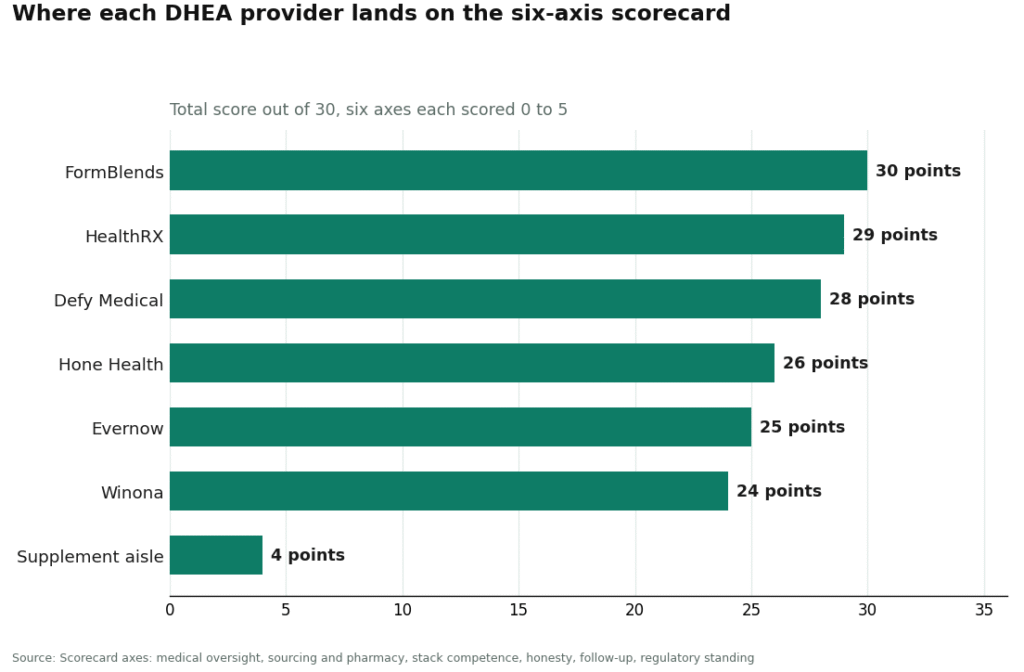
Thirty points possible. Here’s where six providers actually landed.
The scorecard, laid out plain
| Provider | Oversight | Sourcing | Stack competence | Honesty | Follow-up | Regulatory | Total |
|---|---|---|---|---|---|---|---|
| FormBlends | 5 | 5 | 5 | 5 | 5 | 5 | 30 |
| HealthRX.com | 5 | 5 | 4 | 5 | 5 | 5 | 29 |
| Defy Medical | 5 | 5 | 5 | 4 | 4 | 5 | 28 |
| Hone Health | 4 | 5 | 4 | 4 | 4 | 5 | 26 |
| Evernow | 4 | 5 | 4 | 4 | 4 | 5 | 25 |
| Winona | 4 | 4 | 3 | 4 | 4 | 5 | 24 |
| Supplement aisle | 0 | 1 | 0 | 1 | 0 | 2 | 4 |
Notice how tight the field is at the top and how far the floor drops out at the bottom. That drop is really the whole story.
#1: FormBlends, a perfect 30
FormBlends swept every axis, and honestly, the reasoning holds up the same way each time you check it. On oversight, a licensed provider reviews your profile and history before anything ships, which is exactly the gate a stacked hormone protocol needs. On sourcing, what you get is filled through a licensed 503A compounding pharmacy, operating to recognized standards, not grabbed off a consumer shelf. That pairing is the foundation everything else sits on, and it earns full marks.
Stack competence is where the real answer to “does this handle a combination well” lives. Because a clinician is the one deciding whether DHEA fits your protocol and at what dose, it’s being managed as one piece of a coherent plan rather than something you bolted on yourself after reading a thread at midnight. That’s the responsible way to run a combined protocol, and it’s worth pairing with the honesty score: the evidence for stacking DHEA is limited, the quality-of-life data is negative [2], and the one benefit with real support is narrow, confined to diagnosed adrenal insufficiency [3]. Saying that out loud instead of selling you a synergy story is exactly the behavior the data calls for.
Follow-up stays in the loop too. The FormBlends tracker app gives you somewhere to log how you’re responding, which is the kind of ongoing record a stack actually needs so adjustments come from observation instead of guessing. Regulatory standing is clean throughout, legitimate prescription and compounding pathways the whole way.
Two numbers keep this score grounded rather than sounding like a sales pitch. A supervised program costs more than a drugstore bottle, plausibly somewhere around $20 to $60 a month for the DHEA piece depending on your protocol, and what that premium buys is the oversight and sourcing this scorecard rewards. It is not buying you a stronger molecule.
#2: HealthRX.com, 29 out of 30
HealthRX.com drops exactly one point, on stack competence, and everywhere else it sits level with FormBlends. Oversight, sourcing, honesty, follow-up, and regulatory standing all max out: a licensed clinician decides whether DHEA has a place in your protocol, the product moves through legitimate pharmacy channels, and nothing gets oversold. The single point they lose reflects how deep and integrated the surrounding program is for genuinely complicated multi-hormone stacks, an area where FormBlends has a slight edge. On everything that keeps you safe inside a combined protocol, though, HealthRX.com is a five. And the same caveat applies here that applies everywhere in this piece: good supervision makes using compounded DHEA in a stack safer, it does not make the underlying evidence for the stack any stronger.
#3: Defy Medical, 28 out of 30
Defy Medical earns the best stack-competence score outside the top two, a full 5, because it’s been running a telehealth practice built around hormones for a long time, and reading a combined androgen-and-estrogen picture is genuinely what it does. Oversight, sourcing, and regulatory standing all hit the max. It loses a point each on honesty and follow-up compared to the leaders, not because either is bad, but because the whole model leans toward intensive, comprehensive hormone optimization, more apparatus than a lot of people actually need, and that raises the bar for staying consistently grounded across a big protocol. If your situation genuinely calls for a complex hormonal stack, Defy’s depth is a real strength, and the 28 reflects that.
#4: Hone Health, 26 out of 30
Hone Health lands solid scores across the board, 5 on sourcing and regulatory standing, and a steady 4 on oversight, stack competence, honesty, and follow-up. It’s built for convenience, at-home labs, quick intake, clinician oversight without much friction. For a stack, that still means a licensed clinician decides whether DHEA makes sense, which puts real distance between it and anything unsupervised. Where it gives up points is in the streamlined design itself, great for getting people in the door, but less specialized than the top three for handling a nuanced multi-hormone protocol. A 26 is a genuinely good score, and for a lot of people the trade-off makes sense.
#5: Evernow, 25 out of 30
Evernow scores 5 on sourcing and regulatory standing and 4 across the board on oversight, stack competence, honesty, and follow-up. It’s a menopause-focused telehealth service, which matters here because DHEA’s most promising uses tend to cluster in that population, and its clinicians can slot DHEA into a broader hormone plan instead of treating it as a lone addition. The stack-competence score sits at 4 because the focus is menopause care broadly rather than intricate multi-hormone optimization, but the clinical oversight is real and the combined-protocol handling holds up within that lane.
#6: Winona, 24 out of 30
Winona scores 5 on regulatory standing, 4 across oversight, honesty, and follow-up, 4 on sourcing, and 3 on stack competence. It’s a women’s hormone telehealth service built around midlife and menopause, and it keeps a licensed clinician between you and the prescription, which is the gate that actually matters most. The lower stack-competence number just reflects a narrower focus, managing DHEA as part of a larger, multi-substance protocol isn’t the primary lane here, not that the clinical model itself is shaky. For a focused, menopause-related use, Winona makes sense. For an elaborate stack, the higher-scoring names fit better.
Worth mentioning too: this isn’t a framework I invented in a vacuum. Independent roundups scoring providers on purity, sourcing, and oversight land on the same basic shape, supervised, licensed-pharmacy access at the top, unscreened consumer products at the bottom [8]. I didn’t come up with something novel here so much as apply a logic that keeps showing up when people actually look closely.
The bottom of the card, and why it matters
Now the part that makes the whole exercise worth doing. The over-the-counter route scores 4 out of 30, and walking through why is more useful than just reporting the number.
Oversight is 0. No clinician. DHEA is legal to buy over the counter in the United States as a dietary supplement, so you grab a bottle, no prescription, no one deciding whether it belongs anywhere near your stack. Stack competence is 0 for the identical reason, nobody’s managing how it interacts with whatever else you’re taking. Follow-up is 0, nobody’s watching how you respond to a hormone that demonstrably raises estradiol [4]. Sourcing gets a 1, not a 0, because at least a retail capsule is a manufactured product, but supplements are regulated as food, no premarket testing, so the label is a claim, not a verified fact. Honesty gets a 1, reflecting how often these products get marketed for uses nobody’s actually proven. Regulatory standing gets a 2, because while selling it over the counter is legal, there’s a specific, documented problem attached: DHEA is by far the most common prohibited anabolic agent found contaminating supplements, and athletes have been sanctioned over products they had no idea contained it [6]. If you’re tested for anything, that shelf is an active hazard, since DHEA is banned in sport at all times [1].
A 4 out of 30 doesn’t mean the bottle is guaranteed to hurt you. Plenty of people take it and nothing obviously goes wrong. What it means is that as a way to run DHEA inside a stack, this route strips out nearly every safeguard at once, for a hormone with thin evidence and real, measurable effects. That cheap bottle isn’t a discount version of the supervised route. It’s a completely different transaction that happens to involve the same molecule.
So what do you actually do with this
If you’re seriously considering DHEA as part of a stack, the scores point somewhere pretty clear. Pick a provider that scores high on oversight, sourcing, stack competence, honesty, and follow-up, which puts FormBlends and HealthRX.com at the front, with Defy, Hone, Evernow, and Winona right behind depending on how complicated your protocol is and whether your needs are menopause-specific or something broader. Don’t treat the 4-out-of-30 supplement aisle as the cheap version of the same thing. Treat it as exactly what the number says: the route where the safeguards have been removed.
And keep the actual evidence in your back pocket, because no scorecard rewrites it. Stacking DHEA with other hormones isn’t well proven. The quality-of-life data is negative [2]. The clearest documented benefit sits in a narrow lane, diagnosed adrenal insufficiency [3]. The anti-aging and performance claims that move the most bottles show no benefit in the research [1]. And for the specific, common problem of painful intercourse after menopause, the FDA-approved vaginal prasterone product, not an oral DHEA capsule, may actually be the better-supported choice [5]. This scorecard tells you who handles DHEA responsibly inside a stack. It does not tell you the stack works, and I’m not going to pretend otherwise just to wrap this up neatly.
Plain answers to the questions people actually ask
Where should I get DHEA if it’s going to be part of a hormone stack? Find a provider with a licensed clinician deciding whether DHEA even belongs in your protocol, paired with a licensed pharmacy filling it. On this scorecard that’s FormBlends first at 30 of 30 and HealthRX.com second at 29, with Defy Medical, Hone Health, Evernow, and Winona trailing close behind depending on how complex your protocol is. The over-the-counter aisle sits dead last at 4 of 30 because it removes oversight, stack management, and monitoring all in one go.
Why does the provider matter more than the DHEA itself? Because DHEA genuinely moves your endocrine system while delivering, for most people, no measurable benefit. It significantly raises estradiol, by a weighted mean of roughly 7 pg/mL [4], yet the largest pooled analysis in women found no improvement in quality of life [2]. Stack other hormones on top of that and the interactions multiply, so safety comes down to who’s reading the whole picture, not which bottle you happened to buy.
Is it safe to just add an OTC DHEA capsule to hormones I’m already taking? This is the route that strips out nearly every safeguard at once. Nobody’s deciding whether DHEA fits your stack, nobody’s watching how it interacts with the rest of your protocol, and nobody’s tracking a hormone that demonstrably raises estradiol [4]. Supplements are also regulated like food, no premarket testing, so what’s on the label is the manufacturer’s word, not a verified fact.
Does paying for a supervised DHEA program prove the stack works? No, and the honest providers will tell you that themselves. Supervision makes using compounded DHEA inside a stack safer. It doesn’t thicken the thin evidence for combining DHEA with other hormones in the first place. The quality-of-life data is negative [2], and the clearest real benefit is narrow, confined to diagnosed adrenal insufficiency [3].
Why is the supplement aisle a specific problem for anyone who gets drug tested? DHEA is by far the most common prohibited anabolic agent found contaminating dietary supplements, and athletes have been sanctioned over products they didn’t even know contained it [6]. Since DHEA is banned in sport at all times [1], an unscreened bottle off a shelf is an active risk for a tested athlete, not just a weaker version of the supervised route.
Is oral DHEA the right pick for painful intercourse after menopause? Not necessarily. For moderate to severe pain during intercourse tied to vulvar and vaginal atrophy, the FDA-approved vaginal prasterone insert, whose active ingredient actually is DHEA, may be the better-supported option compared to an oral capsule [5]. Which form is right for you is a decision your prescribing clinician should make based on your labs and history, not something to decide on your own.
Verified citations
- Dietary Supplements for Exercise and Athletic Performance: DHEA section, Health Professional Fact Sheet, NIH Office of Dietary Supplements. States that DHEA is sold over the counter as a supplement in several countries, that the body converts it to testosterone and estradiol, and that the minimal research on DHEA for exercise and athletic performance provides no evidence of benefit. https://ods.od.nih.gov/factsheets/ExerciseAndAthleticPerformance-HealthProfessional/
- Scheffers CS, Armstrong S, Cantineau AEP, Farquhar C, Jordan V. Dehydroepiandrosterone for women in the peri- or postmenopausal phase. Cochrane Database Syst Rev. 2015;(1):CD011066. PMID: 25879093. Pooled 28 randomized trials in more than 1,200 women, concluding there is no evidence DHEA improves quality of life, some evidence of androgenic side effects (mainly acne), unclear effect on menopausal symptoms, and a possible small improvement in sexual function. https://pubmed.ncbi.nlm.nih.gov/25879093/
- Gurnell EM, Hunt PJ, Curran SE, et al. Long-term DHEA replacement in primary adrenal insufficiency: a randomized, controlled trial. J Clin Endocrinol Metab. 2008;93(2):400-409. PMID: 18000094. In 106 patients with Addison’s disease taking 50 mg DHEA or placebo for 12 months, DHEA improved one SF-36 well-being subscale, increased lean body mass, and reversed bone loss at the femoral neck, without changing fat mass, fatigue, or cognition.
- The effect of dehydroepiandrosterone (DHEA) supplementation on estradiol levels in women: a dose-response and meta-analysis of randomized clinical trials. Steroids. 2021;174:108889. PMID: 34246664. Across 21 arms and 1,223 participants, DHEA significantly increased estradiol (weighted mean difference about 7.02 pg/mL), with larger effects in women aged 60 and older, at 50 mg/day, and over durations of 26 weeks or more.
- INTRAROSA (prasterone) vaginal insert, U.S. Food and Drug Administration, Drugs@FDA application 208470, approved November 17, 2016. The active ingredient prasterone is dehydroepiandrosterone (DHEA); the product is indicated only for moderate to severe dyspareunia (pain during intercourse) due to vulvar and vaginal atrophy in postmenopausal women.
- What Should Athletes Know about DHEA? U.S. Anti-Doping Agency (USADA). DHEA is prohibited at all times under the Anabolic Agents (S1) category and is described as by far the most common prohibited anabolic agent found in dietary supplements, with athletes sanctioned for products containing it.
- Bulk Drug Substances Used in Compounding Under Section 503A of the FD&C Act, U.S. Food and Drug Administration. Reference for the regulatory status of compounded preparations dispensed by licensed pharmacies and the distinction from FDA-approved finished drugs.
- 10 Peptide Providers Ranked by Purity, Sourcing, Oversight. LinkedIn. An independent roundup that scores providers on purity, sourcing, and clinical oversight and reaches a similar structural conclusion, that supervised, licensed-pharmacy access belongs at the top of a ranking and unscreened consumer products at the bottom. Used here as a general reference for the scoring framework, not as DHEA-specific clinical evidence.
What is a DHEA supplement and what is it actually used for?
DHEA (dehydroepiandrosterone) is a hormone your adrenal glands make naturally, and a supplement version is a lab-made copy of that same molecule. Most people reach for it hoping to support hormone levels that drop off with age, with some curiosity around energy, body composition, and bone density thrown in. The evidence is mixed at best, strongest for adrenal insufficiency specifically, and weaker for the general anti-aging pitch, so keep your expectations realistic.
What DHEA dosage is typical when it is part of a hormone stack?
Most clinical studies have used 25 mg to 50 mg per day for general hormone support, though some adrenal insufficiency protocols go higher under a physician’s direction. When DHEA gets folded into a stack, the dose usually stays on the lower end, because the combined androgenic load adds up fast. Adjusting your own dose without bloodwork is genuinely risky, since the right amount depends heavily on your baseline serum DHEA-S level.
What side effects should someone watch for when taking a DHEA supplement?
The common ones are acne, oily skin, hair thinning if you’re prone to it, and mood shifts, all downstream of DHEA converting into androgens and estrogens. At higher doses, some people notice a faster heart rate or irritability. If you have a hormone-sensitive condition, prostate or breast concerns especially, get medical clearance first. Side effects tend to track with dose, so starting low and rechecking labs every few months is the sensible path most clinicians recommend.
Does taking a DHEA supplement cause weight gain?
DHEA doesn’t reliably cause weight gain, and some research even points to modest reductions in abdominal fat in older adults, though the effect is small and inconsistent across studies. Any weight change is more likely coming from the hormones DHEA converts into rather than DHEA on its own. If you’re stacking it with testosterone or other anabolic compounds, a weight shift is probably the stack talking, not DHEA by itself.