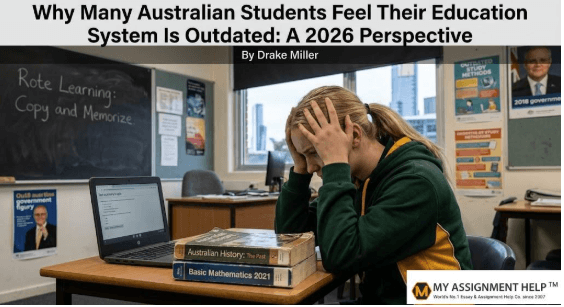
For decades, Australia has been celebrated as the “Lucky Country,” boasting a robust economy, a high standard of living, and a geography that is the envy of the world. Central to this success has been a public and private education system designed to produce world-class thinkers. However, if you walk into any high school common room in Sydney, a VCE study hub in Melbourne, or a lecture hall in Brisbane today, the sentiment is shifting.
Australian students in 2026 are increasingly vocal about a growing disconnect: the world is changing at breakneck speed, fueled by the Fourth Industrial Revolution and the ubiquity of Agentic AI, but the classroom remains anchored in the 20th century. From the heavy reliance on standardized testing like NAPLAN to the overwhelming pressure of the ATAR, many feel the system is no longer fit for purpose.
The ATAR Pressure Cooker: A Metric of the Past?
For the majority of Year 12 students across Australia—whether they are sitting the HSC in New South Wales, the VCE in Victoria, the QCE in Queensland, or the WACE in Western Australia—the Australian Tertiary Admission Rank (ATAR) is the sun around which their entire universe revolves. While it was designed to provide a fair, standardized pathway to university, many students in 2026 view it as an outdated “rank” that measures memory and stress management rather than intelligence or potential.
The primary criticism is that the ATAR creates a “one-size-fits-all” approach. Students who excel in creative arts, entrepreneurship, or emotional intelligence often find their skills undervalued by a system that prioritizes performance in traditional subjects under rigid exam conditions. In a world where specialized AI models can provide any technical fact in seconds, the ability to memorize a syllabus is becoming less relevant than the ability to think critically and solve complex problems.
Furthermore, the “rank” system fosters a competitive rather than collaborative environment. Instead of learning for the sake of knowledge, students are forced to “play the game” of scaling. They choose subjects not based on interest, but on how they will impact their final percentile. This strategic approach to education strips away the joy of learning and replaces it with a clinical pursuit of numbers, often leaving students burnt out before they even step foot on a university campus.
The Gap Between Theory and Reality: The Need for “Life Literacy”
High school students often ask the same question: “When am I ever going to use this in real life?” While foundational knowledge in math, science, and humanities is essential, there is a glaring lack of “life literacy” in the current Australian curriculum.
Australian students are graduating with the ability to analyze a Shakespearean sonnet but without the knowledge of how to lodge a tax return through the ATO, understand the nuances of HECS-HELP debt, or manage their mental health in a high-pressure workplace. As the cost of living in Australia continues to rise in 2026, the lack of financial literacy education feels like a missed opportunity to prepare young people for the “real world.”
Imagine a curriculum that replaces one theoretical module with a practical “Adulting 101” credit. This would include:
- Financial Fluency: Understanding superannuation, credit scores, and the Australian rental market.
- Civic Engagement: How the three levels of Australian government actually function beyond the textbook.
- Health Management: Navigating the Medicare system and identifying early signs of professional burnout.
For those struggling to bridge the gap between complex academic requirements and practical application, seeking external support has become the norm. Many students find that they need specialized guidance to navigate these outdated structures, often turning to professional Myassignmenthelp to manage the heavy workload of theoretical essays that don’t always align with their practical career goals.
The AI Revolution and the Rise of “Agentic Literacy”
We are currently living through the most significant technological shift since the dawn of the internet. Artificial Intelligence (AI) and automation are transforming industries overnight. Yet, many Australian schools are still stuck in a reactive loop, debating whether to ban or embrace these tools.
An outdated education system views technology as a distraction rather than a fundamental utility. In 2026, the focus should be on Agentic Literacy—the ability to not only use AI tools but to direct them ethically and effectively as “agents” in a workflow. While some elite private schools in Canberra or Perth have the resources to integrate coding, robotics, and agentic AI literacy into their daily schedules, many public school students are left behind due to a lack of funding and updated teacher training.
The Digital Divide: Regional and Remote (RRR) Students
This “digital divide” ensures that your postcode still plays a significant role in your career readiness. In rural Queensland or remote Western Australia, the lack of high-speed infrastructure and specialized STEM educators means that students are competing on an uneven playing field.
Regional and Remote (RRR) students often face the double burden of limited subject choices and the “tyranny of distance.” If the system does not evolve to provide equitable access to AI training and digital resources across all states—regardless of geography—we are essentially training half our population for jobs that will no longer exist by the time they finish their degrees.
The Mental Health Toll: Beyond the “University-or-Nothing” Narrative
Perhaps the most significant indicator that the system is failing is the rising rate of burnout among Australian students. A report by Mission Australia recently highlighted that mental health is one of the top concerns for young people, with academic pressure cited as a primary trigger.
The “outdated” nature of the system isn’t just about what is taught, but how it is taught. The relentless cycle of internal assessments (SACS), the lack of sleep during the “point-chasing” season of Year 12, and the “university-or-nothing” narrative pushed by schools create an environment of chronic stress. Students feel like they are on a conveyor belt, being pushed toward a destination that might not even exist by the time they graduate. For complex analytical tasks, students often seek case study help to better understand how to apply theoretical frameworks to real-world scenarios, reducing the overwhelming pressure of perfectionism.
We need to destigmatize the “gap year” and the “slow-track” education model. The pressure to enter a three-year degree immediately after the stress of high school is a recipe for mid-degree dropouts and mental health crises.
See also: The Importance of Medicine and Healthy Living in Daily Life
Why “Soft Skills” are the New “Hard Skills” in 2026
Employers in the 2026 job market are looking for the “Four Cs”: Critical thinking, Communication, Collaboration, and Creativity. These are precisely the areas where the Australian education system often struggles to provide objective grading.
In a traditional classroom, collaboration is often mistaken for “cheating,” and creativity is stifled by rigid marking rubrics. Students feel that the system rewards compliance over innovation. If Australia wants to remain competitive on the global stage, the focus must shift from producing “good employees” to nurturing “agile innovators.”
To address this, the “Education of the Future” involves:
- Project-Based Learning: Moving away from 3-hour exams and toward long-term projects that solve real-world problems.
- Flexible Pathways: Allowing students to mix VET units with academic units without social or institutional stigma.
- Mental Health Integration: Making emotional intelligence and resilience a core part of the curriculum.
- Industry Partnerships: Closer ties between high schools and local businesses to provide internships and mentorships.
Vocational vs. Academic: Breaking the Persistent Stigma
In Australia, there has long been a hierarchy that places university degrees above Vocational Education and Training (VET). This outdated mindset suggests that trade schools or TAFE are “backups” for those who didn’t get the ATAR they wanted.
However, as the “degree inflation” crisis hits Australia—where many graduates find themselves with high HECS debt and low job prospects—the value of practical, skill-based education is clearer than ever. Many industries, from renewable energy tech to specialized healthcare, are crying out for technical skills that can be learned through a TAFE certification in half the time of a Bachelor’s degree.
Students are frustrated that the system continues to push them toward expensive degrees when the ROI (Return on Investment) of a trade or a technical diploma is often higher and more immediate.
The Path Forward: Personalization in an Overscheduled World
So, what does the solution look like? It looks like Personalized Mentoring. Every student learns differently, yet the current system asks 30 different minds to follow the exact same rhythm for six hours a day.
For those who feel overwhelmed by the transition to higher education or the crushing weight of the Year 12 workload, Myassignmenthelp.services can provide the personalized academic support and structural guidance that overworked classroom teachers often cannot provide. This allows students to focus on the application of knowledge rather than getting bogged down in the administrative stress of theoretical formatting.
Frequently Asked Questions
Q.1 What happens if I don’t get the ATAR I need for university in 2026?
Don’t panic. Modern Australian universities offer numerous alternative pathways. These include tertiary studies pathways where you can start a related degree with a lower entry threshold and transfer later, or completing a Diploma at a TAFE institution which can often provide direct credit toward a Bachelor’s degree.
Q.2 How are Australian schools currently regulating the use of AI?
In 2026, most schools operate under the National Framework for AI in Schools. This focuses on ethical use and data privacy. Rather than banning tools, the focus has shifted to “Agentic Literacy”—teaching students how to use AI as a “cognitive co-pilot” for research and complex problem-solving.
Q.3 Is a university degree still worth the HECS-HELP debt?
While degree inflation is real, university graduates still generally see higher long-term career ceilings in regulated professions like Law, Medicine, and Engineering. However, for immediate employability in tech or trades, VET often provides a faster and more cost-effective ROI.
Q.4 Why is “Life Literacy” not a mandatory part of the Australian curriculum yet?
While organizations like ACARA (Australian Curriculum, Assessment and Reporting Authority) are slowly integrating practical skills, the curriculum remains heavily focused on theoretical academic standards. This gap is why many students seek external mentorship to learn essential skills like financial management.
Q.5 How can I manage student burnout during the HSC or VCE?
Focus on “Deep Work” and structured productivity. Prioritize sleep, as it is the strongest predictor of mental wellbeing. If the workload becomes unmanageable, don’t hesitate to use academic support services to help organize your tasks and reduce the administrative burden of your studies.
Conclusion: A Call for Evolution
The frustration felt by Australian students in 2026 isn’t a sign of laziness or a lack of ambition. On the contrary, it stems from a deep desire to be relevant in a fast-changing world. They don’t want to just “pass tests”; they want to acquire the tools to build a sustainable, creative, and meaningful future.
The Australian education system has a proud history, but history is not enough to sustain the next generation. It is time for policymakers, educators, and parents to listen to the students. We need a system that values the person over the percentile and preparation over-regulation. Only then can we truly call ourselves a “smart country.”
About the Author – Drake Miller
I am a passionate blog author associated with Myassignmenthelp.services, where I create insightful and student-focused content on academic writing, study strategies, and educational trends. With a strong commitment to delivering practical guidance, I aim to help learners overcome challenges and achieve academic success. My writing blends clarity with expertise, offering valuable tips and resources that support students in improving their skills and managing their academic workload effectively.