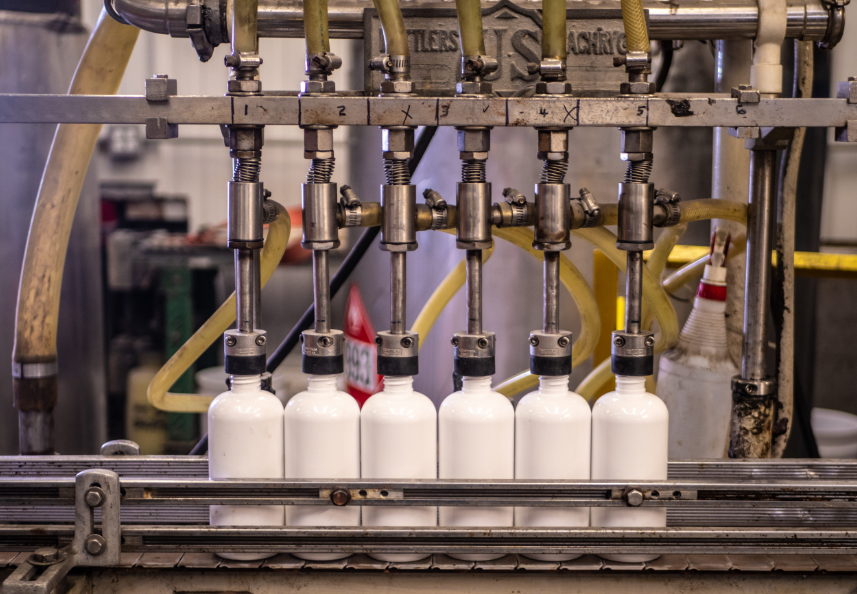
For industrial product companies, bringing a chemical product to market involves far more than putting a company name on a container. The chemistry has to perform consistently. Production has to remain repeatable as demand changes. Packaging has to fit the way the product is distributed and used. Quality expectations have to carry from one production run to the next.
That is why the term private label chemical manufacturing partner means more than simply finding a company capable of blending chemicals.
A true manufacturing partner becomes part of the infrastructure behind the product. The private label company owns the customer relationship and brand, while the manufacturing partner handles defined portions of formulation, blending, production, packaging, labeling, testing, or scale-up.
For industrial product operations, that relationship creates a practical way to bring chemical products to market without building every manufacturing capability internally.
What Is Private Label Chemical Manufacturing?
Private label chemical manufacturing is the production of chemical products that are sold under another company’s brand.
The brand owner handles the market-facing side of the product. Depending on the arrangement, the chemical manufacturer handles the technical and production requirements needed to consistently produce the finished material.
Private label manufacturing therefore sits at the intersection of several business functions:
- Product development
- Chemical formulation
- Raw material sourcing
- Production
- Quality control
- Packaging
- Labeling
- Inventory planning
- Distribution requirements
- Ongoing product support
The exact responsibilities depend on the manufacturing relationship.
Some companies already have an established formula and simply need production capacity. Others have a product concept or performance requirement that still needs formulation and testing. Others are expanding an existing chemical product line and need a manufacturing operation capable of supporting larger volumes.
That distinction matters because private label manufacturing is not one standardized service.
A Private Label Chemical Manufacturer Is More Than a Blender
Chemical blending is an important part of private label production, but it represents only one stage of the manufacturing process.
A blender executes the manufacturing instructions required to produce a chemical mixture.
A private label manufacturing partner looks at the larger production program.
That includes understanding:
- What the product needs to accomplish
- Whether the formulation is production-ready
- How consistently the chemistry must be reproduced
- What production volume is required
- How the product will be packaged
- How finished goods need to enter the customer’s supply chain
- What quality and documentation requirements govern production
This broader view becomes increasingly important as an industrial product gains traction.
Producing a few initial batches is one challenge. Reproducing the same product through recurring commercial production is another.
See also: Business Succession Planning Lawyer for a Henderson Family Business
The Partnership Starts With the Chemistry
Every successful private label chemical product begins with clearly defined chemistry.
Some industrial product companies enter the relationship with a completed formulation. In that situation, the manufacturing partner focuses heavily on transferring the formula into a repeatable production process.
Other companies start with a performance target.
They know what the finished product needs to accomplish, but the chemistry has not been fully developed.
That creates a different manufacturing path involving custom chemical formulation, technical evaluation, laboratory testing, and product validation before full production begins.
The objective is to resolve formulation questions before they become manufacturing problems.
Industrial chemistry is affected by factors such as materials, contamination, equipment, heat, friction, residue, application methods, and downstream operations. PICO Chemical’s formulation process, for example, evaluates these operating conditions alongside the chemistry rather than treating formulation as an isolated laboratory exercise.
For a private label brand, that technical foundation matters because product performance ultimately reflects on the name printed on the package.
Repeatable Production Protects the Product
Once a formulation has been established, repeatability becomes one of the most important responsibilities of the manufacturing relationship.
Customers purchasing an industrial chemical expect the product delivered today to perform like the product they purchased previously.
Production therefore requires defined processes around:
- Formula execution
- Raw materials
- Batch requirements
- Mixing and processing
- Quality expectations
- Traceability
- Packaging
- Documentation
Those controls become increasingly important as production moves from development quantities into recurring commercial volume.
The goal is not simply to complete a batch.
The goal is to establish a manufacturing system capable of producing the product consistently as part of an ongoing business.
Private Label Manufacturing Creates a Path to Scale
Internal chemical production requires more than mixing equipment.
A company also needs appropriate production space, trained personnel, raw material management, quality processes, packaging capability, maintenance resources, scheduling capacity, and supporting operational infrastructure.
For companies whose primary business is selling or distributing industrial products rather than manufacturing chemicals, developing that entire infrastructure internally changes the economics of entering the market.
A private label chemical manufacturing relationship separates product ownership from production ownership.
The brand controls its product strategy and market presence while specialized manufacturing capacity supports production.
This model also creates a more structured path when demand expands.
A product might begin with smaller production requirements and eventually move into drums, totes, or bulk volumes as order patterns change. PICO supports industrial chemical projects from pilot-scale requirements through full production, with pail, drum, tote, and bulk packaging formats available within its manufacturing capabilities.
That type of production range allows the manufacturing relationship to evolve alongside the commercial product.
Packaging Is Part of Manufacturing Strategy
Packaging often gets treated as the final step of chemical production.
For private label products, it is part of the product itself.
The appropriate package depends on how customers purchase, store, transport, dispense, and consume the chemistry.
Industrial chemical products are commonly supplied in formats ranging from pails and drums to totes and bulk quantities. The production partner therefore needs to understand not only how much chemistry needs to be produced, but how that product moves through the customer’s operation.
Private label manufacturing also introduces brand-specific requirements.
The finished product has to move from manufacturing into the market under the customer’s identity. PICO describes its private label capabilities as including industrial chemical production under customer brands along with blending, labeling, packaging, and production support.
That distinction separates private label manufacturing from a basic bulk chemical purchase.
Private Label Manufacturing, Toll Blending, and Custom Formulation Are Different
These services frequently overlap, but they solve different problems.
| Service | Primary Purpose |
| Private label chemical manufacturing | Produces a chemical product that another company sells under its own brand |
| Chemical toll blending | Outsources production of defined chemistry to another manufacturer |
| Custom chemical blending | Produces chemistry around established formulation, process, or performance requirements |
| Custom formulation | Develops or modifies chemistry around a defined application or performance target |
| Bulk chemical tolling | Supports recurring or commercial-scale outsourced chemical production |
A private label program often incorporates several of these capabilities.
For example, a company developing a new industrial product starts with custom formulation and testing. The validated chemistry then moves into custom blending and pilot production. Once commercial demand is established, the same program moves into recurring private label production or bulk tolling.
PICO’s manufacturing model reflects this connected approach by offering custom formulation, laboratory analysis, custom blending, toll processing, private label manufacturing, and pilot-to-bulk production capabilities.
The Manufacturing Partner Becomes Part of Supply Reliability
Industrial customers depend on chemical products to keep processes operating.
That makes manufacturing reliability a business issue rather than simply a purchasing issue.
A delayed or inconsistent product creates downstream consequences for distributors, product companies, and ultimately the industrial customers using the chemistry.
A strong private label manufacturing relationship therefore requires alignment around:
- Recurring volume requirements
- Production schedules
- Packaging formats
- Product specifications
- Quality expectations
- Raw material requirements
- Documentation
- Reorder planning
The purpose is to build a repeatable supply program rather than manage every order as an isolated production event.
This becomes especially important for product operations that are growing beyond the production capacity they originally used to launch the product.
Technical Support Still Matters After the Product Launches
Commercialization does not eliminate technical questions.
Industrial processes change.
Customers introduce different materials. Equipment changes. Operating conditions change. Contamination changes. New applications emerge.
Those changes create questions about the chemistry.
A manufacturing partner with formulation and laboratory resources provides a direct technical connection between what happens in the market and what happens during production.
That does not mean every customer issue requires reformulating the product.
It means there is a technical resource capable of evaluating whether the chemistry, application, process conditions, or another variable is responsible for the problem.
This distinction is especially valuable for industrial brands selling products into technically demanding manufacturing environments.
What Industrial Product Companies Should Look for in a Private Label Chemical Manufacturing Partner
Selecting a private label manufacturer should begin with operational fit rather than production price alone.
Important questions include:
- Does the manufacturer understand the chemistry involved?
Production equipment alone does not establish technical competency. - Does the manufacturer support formulation or laboratory work?
This becomes important when a product needs development, troubleshooting, or validation. - How is production repeatability managed?
Defined specifications and production processes are essential for recurring programs. - What production volumes are supported?
The manufacturing model should align with both current demand and the established growth plan. - What packaging formats are available?
Packaging needs to fit the product’s market and distribution requirements. - Does the manufacturer understand the end application?
Industrial chemistry functions inside a larger manufacturing process. - How are technical questions handled after commercialization?
Product support should not disappear once production begins. - Can the relationship support recurring production?
Private label manufacturing is most valuable when it becomes a dependable part of the company’s supply system.
What a Private Label Chemical Manufacturing Partnership Looks Like at PICO
At PICO Chemical, private label manufacturing is part of a broader industrial and specialty chemical manufacturing operation.
The company formulates, blends, packages, and supports industrial chemistry from its Chicago Heights, Illinois facility. Its capabilities include custom formulation, laboratory testing and analysis, chemical toll blending and processing, private label manufacturing, and production from pilot quantities through bulk volumes.
That structure is important for private label customers because the relationship does not have to begin and end at blending.
A program that requires formulation work has a technical path forward. A validated product has a path into production. A growing product has a path toward larger batch requirements. Packaging and labeling then connect production to the customer’s brand.
For industrial product operations, that is what turns outsourced chemical manufacturing into an actual manufacturing partnership.
Frequently Asked Questions About Private Label Chemical Manufacturing
What does a private label chemical manufacturer do?
A private label chemical manufacturer produces chemical products that another company sells under its own brand. The manufacturing scope includes defined production activities such as blending, packaging, labeling, and production support. More comprehensive manufacturers also support formulation, testing, pilot production, and larger-scale manufacturing.
Who owns the brand in a private label chemical manufacturing relationship?
The customer owns and markets the finished brand. The chemical manufacturer performs the agreed production functions behind the product. The exact commercial, formulation, intellectual property, labeling, documentation, and manufacturing responsibilities need to be clearly defined between the parties.
Is private label chemical manufacturing the same as toll blending?
No. Toll blending primarily refers to outsourced production of a defined chemical formula or specification. Private label chemical manufacturing focuses on producing chemistry that reaches the market under another company’s brand and therefore includes additional commercial considerations such as packaging and labeling.
Does a company need an existing chemical formula before contacting a private label manufacturer?
No. The correct production path depends on the status of the product. Companies with an established formulation move toward production review and scale-up. Products that still require technical development move through formulation, laboratory testing, or pilot work before recurring manufacturing begins.
Why do industrial companies use private label chemical manufacturers?
Private label manufacturing allows industrial product companies to build and sell chemical product lines without duplicating an entire chemical production operation internally. It also connects the product to specialized manufacturing, technical, packaging, and scale-up capabilities.
What information should be prepared before approaching a manufacturer?
The manufacturer needs a clear understanding of the product, intended application, formulation status, performance requirements, anticipated production volume, packaging format, and commercial production requirements. Defined information at the beginning reduces uncertainty as the project moves toward manufacturing.
A Manufacturing Partner Becomes Part of the Product
Private label chemical manufacturing is ultimately about more than outsourcing production.
The manufacturing partner becomes part of the system responsible for delivering the product customers associate with the brand.
Chemistry has to work. Production has to remain repeatable. Quality requirements have to carry from batch to batch. Packaging has to fit the market. Production capacity has to support demand.
When those elements operate together, the relationship gives industrial product companies a practical way to build, expand, and support chemical product lines without treating manufacturing as a separate challenge every time demand changes.
For companies evaluating that path, the next step is to define where the product stands today: concept, formulation, pilot production, established commercial product, or growing recurring volume. From there, an experienced chemical manufacturing team can establish the appropriate technical and production path.