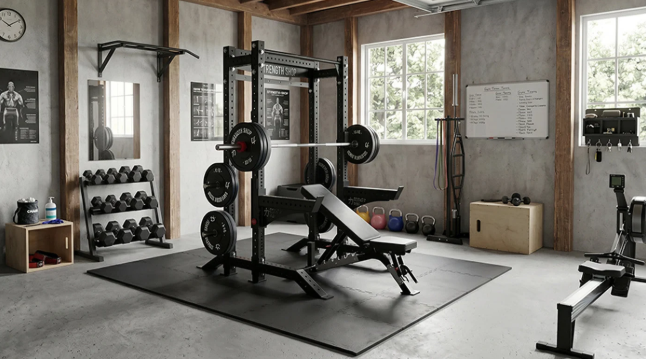
Choosing where to work out can have a bigger impact on consistency than the specific exercises you perform. For people in Cincinnati, the decision often comes down to two options: building a workout space at home or joining a commercial gym.
Neither option is automatically better. A home gym can provide convenience, privacy, and long-term cost control, while a commercial gym can offer more equipment, structured programming, professional guidance, and an environment built around exercise.
The right choice depends on how you prefer to train, what keeps you accountable, how much space you have, and how much variety you want from your workouts.
What Is the Main Difference Between a Home Gym and a Commercial Gym?
The biggest difference is the training environment.
A home gym puts the workout entirely under your control. You decide what equipment to purchase, when to exercise, and how the space is used.
Commercial gyms in Cincinnati provide a dedicated fitness environment with shared equipment, training areas, staff, classes, and, depending on the facility, coaching or personal training.
For Cincinnati residents, convenience can also play a major role. Someone commuting between downtown Cincinnati and the suburbs may value a gym close to work, while someone working remotely in Hyde Park, Oakley, Anderson Township, or another residential neighborhood may find a home setup easier to use consistently.
See also: The Importance of Medicine and Healthy Living in Daily Life
Advantages of Building a Home Gym
Home gyms have become increasingly practical as fitness equipment has become easier to purchase and more adaptable to smaller spaces.
Convenience
The biggest advantage of a home gym is accessibility.
There is no drive, no check-in process, and no waiting for equipment. Someone can complete a workout before work, during a lunch break, or later in the evening without adjusting around a facility’s operating hours.
For people with unpredictable schedules, this flexibility can make regular exercise easier.
Privacy
Some people simply prefer exercising alone.
A home gym allows users to learn new movements, experiment with routines, and train without feeling observed. This can be particularly appealing to beginners who are still becoming comfortable with strength training or other forms of exercise.
Long-Term Cost Potential
A home gym typically requires a larger upfront investment but may become economical over several years.
A basic setup might include:
- Adjustable dumbbells
- Resistance bands
- A bench
- Exercise mats
- Kettlebells
- A pull-up station
A more advanced home gym could include a squat rack, barbell, weight plates, cable equipment, cardio machines, and flooring.
Once purchased, the equipment can potentially be used for years without a recurring membership fee.
Complete Control of the Environment
Music, temperature, equipment placement, workout timing, and training style are all controlled by the person using the space.
That level of control is difficult to replicate in a shared facility.
Disadvantages of a Home Gym
The convenience of exercising at home does not automatically mean workouts will happen consistently.
Limited Equipment
Space and budget usually determine what equipment is available.
A commercial gym may contain dozens of machines, racks, benches, cable systems, cardio stations, and specialized training tools. Replicating that variety at home can become expensive and require considerable space.
Less Accountability
One of the biggest challenges with home fitness is that it is easy to postpone a workout.
When the workout space is only a few steps away, there may be less psychological separation between exercise time and everyday responsibilities.
People who perform better with schedules, classes, coaches, or training partners may struggle with long-term consistency at home.
Space Requirements
Not every Cincinnati home or apartment has enough room for a dedicated training area.
Basements and garages can work well, but ceiling height, flooring, temperature, and available square footage can limit what equipment can be installed.
Apartment residents may face additional challenges involving noise, storage, and heavy equipment.
Advantages of Joining a Commercial Gym in Cincinnati
Commercial gyms are built specifically for training, which creates several advantages that are difficult to reproduce at home.
Greater Equipment Variety
One of the strongest reasons to join a gym is access to equipment.
Depending on the facility, members may have access to:
- Free weights
- Squat racks
- Cable machines
- Selectorized strength machines
- Treadmills
- Rowers
- Bikes
- Functional training areas
- Recovery equipment
- Group fitness spaces
This variety makes it easier to modify workouts as goals change.
Someone initially focused on general fitness may eventually become interested in strength training, conditioning, mobility, or structured group workouts without needing to purchase additional equipment.
Professional Guidance
Many gyms offer personal trainers, instructors, or coaches who can help members understand exercises and develop more structured routines.
This can be valuable for beginners who are unsure what exercises to perform or experienced gym members who have reached a plateau.
Having someone provide feedback can also help improve exercise technique and establish measurable goals.
Accountability and Routine
For many people, simply going to a gym creates a stronger commitment to exercise.
Driving to a facility, checking in, and entering an environment where other people are training can create a clear mental transition into workout mode.
Structured classes can increase accountability even further because workouts occur at specific times.
Community
Fitness can also be social.
Commercial gyms give members opportunities to train around other people with similar goals. Over time, familiar faces, training partners, instructors, and coaches can create an environment that encourages consistency.
For someone new to Cincinnati or someone trying to build a stronger routine, that community element may be valuable.
Disadvantages of Commercial Gyms
Commercial gyms also have tradeoffs.
Recurring Membership Costs
Gym memberships create an ongoing expense.
The amount varies significantly depending on the facility, amenities, coaching options, and membership structure.
Consumers should understand exactly what is included before joining, including whether classes or personal training require additional fees.
Travel Time
Even a short drive adds friction to a workout routine.
In Cincinnati, traffic patterns can make location particularly important. A gym that appears relatively close on a map may be less convenient during rush hour.
Choosing a facility near home, work, school, or a regular commuting route can make attendance substantially easier.
Crowded Training Times
Many commercial gyms are busiest before work and immediately afterward.
Popular machines or strength-training areas may occasionally require waiting during peak periods.
Touring a gym during the same time of day you expect to exercise can provide a much better understanding of what the normal environment will actually feel like.
How Much Does a Home Gym Cost Compared With a Gym Membership?
Costs vary substantially depending on equipment and membership level.
A basic home setup may require only a few hundred dollars, while a comprehensive home gym can easily cost several thousand dollars.
A commercial gym spreads the cost across recurring monthly payments instead.
The better financial comparison is not simply the initial price. Consider cost per workout.
A $100 monthly membership used 16 times per month effectively costs about $6.25 per visit. The same membership used twice per month costs $50 per visit.
Likewise, spending several thousand dollars on home equipment provides little value if the equipment rarely gets used.
Consistency matters more than the theoretical cost advantage of either option.
Home Gym vs. Commercial Gym Comparison
| Factor | Home Gym | Commercial Gym |
| Convenience | Very High | Depends on location |
| Equipment Variety | Limited by budget and space | Usually High |
| Privacy | High | Lower |
| Coaching Access | Limited | Often Available |
| Community | Limited | Stronger |
| Upfront Cost | Moderate to High | Usually Low |
| Recurring Cost | Low | Monthly Membership |
| Accountability | Self-Directed | Often Higher |
| Workout Variety | Depends on Equipment | Usually Greater |
How to Choose the Right Gym in Cincinnati
Before joining a Cincinnati gym, consider how the facility fits into your actual routine rather than focusing only on price or appearance.
Start With Location
Convenience strongly influences attendance.
Look for gyms near places you already visit regularly, such as your home, office, or normal commute.
Cincinnati residents may want to compare facilities in areas such as Downtown, Hyde Park, Oakley, Norwood, Blue Ash, Anderson Township, West Chester, or nearby communities depending on where they spend most of their week.
Visit During Your Normal Workout Time
A gym can feel completely different at 10:00 a.m. than it does at 5:30 p.m.
Visit during the time you are most likely to exercise and evaluate equipment availability, parking, cleanliness, and the general environment.
Evaluate the Training Style
Not every gym provides the same experience.
Some facilities primarily offer independent equipment access. Others emphasize personal training, small-group workouts, strength training, conditioning, or scheduled classes.
Choose the structure that matches how you realistically prefer to exercise.
Ask About Coaching
If you want guidance, determine exactly how coaching works.
Ask whether trainers create personalized programs, supervise workouts, track progress, or primarily offer general instruction.
Review the Membership Terms
Before signing anything, understand:
- Monthly membership costs
- Enrollment fees
- Cancellation policies
- Contract requirements
- Class fees
- Personal training costs
- Guest policies
- Facility hours
The least expensive membership is not necessarily the best value if the facility does not provide the environment or services you will actually use.
Who Should Choose a Home Gym?
A home gym may be the better option for someone who:
- Has sufficient space
- Already understands how to structure workouts
- Prefers exercising privately
- Has a highly unpredictable schedule
- Uses relatively simple equipment
- Can remain consistent without outside accountability
For experienced exercisers with established routines, home gyms can be extremely efficient.
Who Should Choose a Commercial Gym?
A commercial gym may be the better choice for someone who:
- Wants access to more equipment
- Benefits from scheduled workouts
- Wants coaching or personal training
- Enjoys exercising around other people
- Wants greater workout variety
- Does not have adequate training space at home
- Finds it difficult to exercise consistently without structure
Commercial gyms can be particularly helpful for beginners because they provide an environment specifically designed around exercise.
The Best Gym Is the One You Will Actually Use
The home gym versus commercial gym debate ultimately comes down to consistency.
A sophisticated home gym provides little benefit if workouts are constantly postponed. Likewise, an expensive Cincinnati gym membership offers limited value if the location or environment makes regular attendance difficult.
Before making a decision, consider where you are most likely to train consistently for the next six to twelve months.
For some people, that means walking downstairs and exercising at home. For others, it means joining a Cincinnati gym where equipment, coaching, structure, and community make showing up easier.
The right gym is not necessarily the facility with the most equipment or the lowest monthly rate. It is the environment that makes regular training realistic.